Sometimes the most powerful way to make a point is to tell a story. I like making stories up for my kids at bed time. Some of their favorites are “The Story of the Lonely Grape,” and “The Magic Purple Turtle.” I will tell them the story and then end by saying, “Do you know why I told you that story?” And then I tell them the point. Because every good story has a point.
Consider the story of Humpty Dumpty:
Humpty Dumpty sat on a wall.
Humpty Dumpty had a great fall.
But all the king’s horses and all the king’s men,
couldn’t put Humpty Dumpty back together again.
On the surface it seems like a silly children’s story, but it has a very important lesson to it: sometimes things get broken and can’t be fixed.
My friend Charlie Jones was fond of saying, “Make a point, tell a story. Tell a story and make a point. Never make a point without telling a story and never tell a story without a point.”
Stories help us remember the point, understand the point, how to apply the point, or how not to apply the point.
Jesus was a master at telling stories. Jesus’ favorite kind of stories were parables. The word “parable” in the Greek literally means “to set beside.” Parables were stories that had a clear parallel application in reality.
In order to understand the meaning of Jesus’ parables we need to ask three questions:
- Who Jesus was talking to?
- Who or what the characters in the story represent?
- What was the point Jesus was trying to make?
In Matthew 25 Jesus tells three different parables that are meant to teach important lessons about the kingdom of God and the coming Day of Judgment. The first, and the focus for this post and the one following, is often referred to as The Parable of the Ten Virgins or The Parable of the Ten Bridesmaids.
At that time the kingdom of heaven will be like ten virgins who took their lamps and went out to meet the bridegroom. Five of them were foolish and five were wise. The foolish ones took their lamps but did not take any oil with them. The wise, however, took oil in jars along with their lamps. The bridegroom was a long time in coming, and they all became drowsy and fell asleep.
At midnight the cry rang out: ‘Here’s the bridegroom! Come out to meet him!’
Then all the virgins woke up and trimmed their lamps. The foolish ones said to the wise, ‘Give us some of your oil; our lamps are going out.’
‘No,’ they replied, ‘there may not be enough for both us and you. Instead, go to those who sell oil and buy some for yourselves.’
But while they were on their way to buy the oil, the bridegroom arrived. The virgins who were ready went in with him to the wedding banquet. And the door was shut.
Later the others also came. ‘Sir! Sir!’ they said. ‘Open the door for us!’
But he replied, ‘I tell you the truth, I don’t know you.’
Therefore
keep watch, because you do not know the day or the hour.
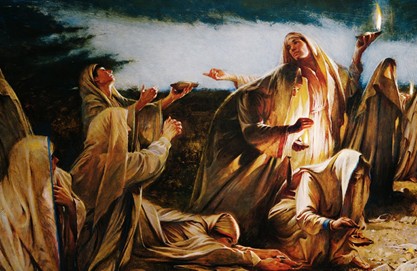
Let’s ask those three questions I mentioned earlier about this parable so that we can begin get our hands around the message of this story.
-
Who was Jesus telling this story to? To get the answer to that we need to go back a bit to chapter 24. Matthew 24:1-3 says,
Jesus left the temple and was walking away when his disciples came up to him to call his attention to its buildings. “Do you see all these things?” he asked. “I tell you the truth, not one stone here will be left on another; every one will be thrown down.” As Jesus was sitting on the Mount of Olives, the disciples came to him privately. “Tell us,” they said, “when will this happen, and what will be the sign of your coming and of the end of the age?”
This is important for two reasons:
Knowing that Jesus was talking to His disciples means that what He is saying to them, also applies to us as His disciples. It tells us the context in which the parable was given. Jesus is answering a specific question the disciples asked Him, “Tell us,” they said, “when will this happen, and what will be the sign of your coming and of the end of the age?” Jesus is talking about the second question in verse 3: what is going to happen when He comes back and the Day of Judgment comes?
- Who do the characters in this passage represent?
The groom represents Christ.
The virgins represent us, the “visible church.” Everyone who claims to be a Christian is part of the visible church. The Church is often called the Bride of Christ.
The vrgins’ lamps represent their profession of support for the groom. The lamps represent our public profession of faith in Christ.
The oil represents the having the Spirit of God which allows us to give light. I remind you of Matthew 5:14-16 (NIV), You are the light of the world. A city on a hill cannot be hidden. Neither do people light a lamp and put it under a bowl. Instead they put it on its stand, and it gives light to everyone in the house. In the same way, let your light shine before men, that they may see your good deeds and praise your Father in heaven. The light represents our actions, our character, our holiness in practice.
The foolish virgins represent people who believe they are Christians but are not. Again, it is important to be aware of the context here. Jesus begins to answer the disciples’ questions saying, in 24:4-5 (NIV) Watch out that no one deceives you. For many will come in my name, claiming, ‘I am the Christ,’ and will deceive many. And then dropping down to verse 10, At that time many will turn away from the faith and will betray and hate each other, and many false prophets will appear and deceive many people. The foolish virgins represent people who have placed their hope in false teaching, believing they have come to Jesus when in fact they never have. Not that they did and were turned away, but that they never really did.
The wise virgins represent people who are true followers of Jesus. The light of their lamps continued to shine until the groom returned. Their faith in Christ and their character and actions all continued to shine to the end.
- What was the point? Jesus reveals the point to us in verse 13: Therefore
keep watch, because you do not know the day or the hour.
We are each responsible for keeping watch over ourselves. We are each responsible for watching over our faith and making sure that it is producing the light, the “good deeds” that give the glory to God that it should.

 Learning To Be Full Of Grace And Truth.
Amen!! Let us stay prepared!! God bless you, my brother!!
LikeLike
Thanks Angel! Love hearing from you my friend! =)
LikeLike
Hi Pastor Dan!! Always great to hear from you too. You are always a blessing!!
LikeLike
My husband and his cousin chose the parable of the 10 virgins as their topic for their online bible reading last week. 🙂 Im glad that you posted this.
LikeLike
I’m always amazed when God does that. It never gets old. Thanks for sharing, and glad it was so timely.
LikeLiked by 1 person
good lesson
LikeLiked by 1 person
Thanks Julie!
LikeLiked by 1 person
Great teaching. It enlighten me in many gray areas. I enjoyed the reading. God Bless
LikeLiked by 1 person
Thank you very much! ☺️👌🙏
LikeLike