Tuesdays with Edwards!
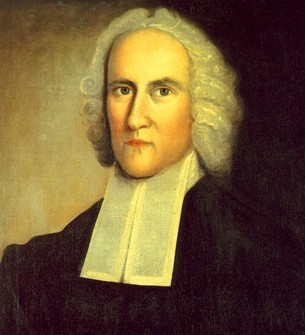
If there was a central question that weighed heavily on the mind of Jonathan Edwards throughout his career it was this: what does the God-centered life look like? That question is still a big one today isn’t it?
Today’s selection is one from a sermon in which Edwards gives his own answer to this question…and it might surprise you.
In this sermon on John 10:4 (KJV), he goeth before them, and the sheep follow him, Edwards argues that the answer to that question is not really in the outward things we often look to like theological orthodoxy, moral behavior, or religious practices, but lies in a harmony of the soul with Christ. This harmony consists in a harmony of
- Mutual respect. Christ sees Himself as the believer’s only Savior and the believer accepts and sees Him in that same way.
- Conformity and likeness. Christ became a human being so that He could know and identify with His people as a human being. Christians become like Christ in “all that is holy.”
- There is a “suitableness” in temper and behavior between them. Our sinfulness is met by His grace. Our weakness is answered in His strength. There is a recognition that Christ is king and that the Christian is submitted to Him, and Christ at the same time is graciously and livingly committed to His people. His grace is responded to with praise and thankfulness, His faithfulness with trust, and Christ’s love of Christians above all others is mirrored by the Christian’s love of Christ above all others.
In applying this, Edwards argues in the selection below that this harmony is the essence of Christianity.
You can read this sermon in its entirety at the Jonathan Edwards Center website at www.edwards.yale.edu. This selection is from Sermons and Discourses, 1734-1738, ed. M.X. Lesser, The Works of Jonathan Edwards, vol. 19 (New Haven: Yale University Press, 2001) page 447.
***
Hence we may learn the nature of true and sincere Christian piety. This shows the nature and genius of Christianity, what that is wherein it most essentially consists. It don’t consist chiefly in any certain profession, or set of principles or tenets; or in any outward form of worship, or an attendance in such or such religious observances; or in outwardly moral behavior; but in such an internal, spiritual harmony between Christ and the soul, as that which has been spoken of.
In that consists the essence of Christianity. He that has this is a Christian; and he that is without it is not worthy of the name, whatever his knowledge, or profession, or orthodoxy, or outward strictness be.
By this, Christianity is most essentially distinguished from all things. By this, ’tis distinguished from the morality of the heathen. And by this, ’tis distinguished [from] the superstition and will-worship of many that are called Christians. And by this, ’tis distinguished from the fair, outward show, or the false affection and zeal of hypocrites. By this, may all pretended descriptions of Christian piety, and precepts to it, and pretenses of it be tried.
The end of the doctrines and precepts of Christianity, is to bring about this sweet harmony between the soul and Jesus Christ. And this is the nature and tendency of them. Whatever doctrines or rules of any profession tend to the contrary, they are to be rejected. And whatever pretenses any make to piety, if their prevailing temper be found contrary to this, they are like to be rejected and acknowledged by Christ as his; for his sheep know his voice and follow him.

 Learning To Be Full Of Grace And Truth.
1 Comment