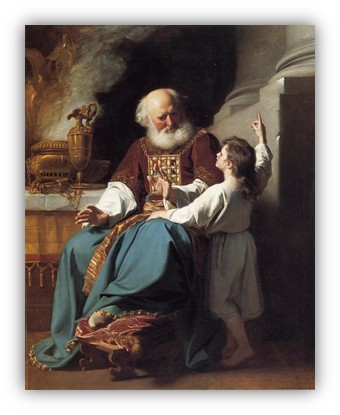
Love is shown by truthfulness. The importance of truthfulness—honesty and trustworthiness—is one of the main lessons in the book of Samuel. 1 Samuel opens with the story of Samuel’s birth. A man named Elkanah had two wives, Peninnah, who had children, and Hannah who had none. At one point Hannah is so distraught over being childless that she goes to the temple and wept and promised that if the Lord would give her a son, she would dedicate him as a Nazarite to the Lord for life. The Lord heard her prayer and answered it, and she gave birth to Samuel. When he was weaned, she kept her promise and brought him to the temple at Shiloh and presented him to the Eli who raised him as a priest.
We are then given some background about the priest Eli and find out that Eli’s sons who were priests with him were wicked men. They forced people to give them the best meat of the sacrifices being brought before they were offered to the Lord. Eli knew about this, he even called them on it, but he did not stop them from doing it. Because of his sons’ dishonesty and because both Eli and his sons proved to be untrustworthy in their role as priests God sent a prophet who told Eli in 1 Samuel 2:27-36,
“This is what the LORD says: ‘Did I not clearly reveal myself to your father’s house when they were in Egypt under Pharaoh? I chose your father out of all the tribes of Israel to be my priest, to go up to my altar, to burn incense, and to wear an ephod in my presence. I also gave your father’s house all the offerings made with fire by the Israelites. Why do you scorn my sacrifice and offering that I prescribed for my dwelling? Why do you honor your sons more than me by fattening yourselves on the choice parts of every offering made by my people Israel?’
“Therefore the LORD, the God of Israel, declares: ‘I promised that your house and your father’s house would minister before me forever.’ But now the LORD declares: ‘Far be it from me! Those who honor me I will honor, but those who despise me will be disdained. The time is coming when I will cut short your strength and the strength of your father’s house, so that there will not be an old man in your family line and you will see distress in my dwelling. Although good will be done to Israel, in your family line there will never be an old man. Every one of you that I do not cut off from my altar will be spared only to blind your eyes with tears and to grieve your heart, and all your descendants will die in the prime of life.
“‘And what happens to your two sons, Hophni and Phinehas, will be a sign to you—they will both die on the same day. I will raise up for myself a faithful priest, who will do according to what is in my heart and mind. I will firmly establish his house, and he will minister before my anointed one always. Then everyone left in your family line will come and bow down before him for a piece of silver and a crust of bread and plead, “Appoint me to some priestly office so I can have food to eat.”‘”
In the next chapter, Samuel is called by the Lord. Samuel hears a voice calling him but thinks its Eli. Eli tells him he wasn’t calling him and sends him back to bed. Three times this happens. Why did it take Eli, who was the chief priest in that place, so many times before he realized Samuel was hearing from God? We are told in 3:1, In those days the word of the LORD was rare; there were not many visions. God had stopped giving visions because His people were not interested in them. They were not concerned about the truth. The priests were using their position for their own private gain. As Jesus said, if you have not been trustworthy in handling worldly wealth, who will trust you with true riches? If Eli and his sons could not be trusted with the sacrifices of the people, how could they be trusted with visions?
Eli finally realizes Samuel is hearing the voice of God and tells him to go back to bed and that if he hears a voice calling his name again to say, Speak Lord, for your servant is listening. Sure enough, Samuel is not long in bed before he hears God calling him again, Samuel! Samuel! And he responded just as he was told. And God told him he was going to fulfill his prophecy of judgment against Eli and his sons.
The next morning, Eli could hardly wait to hear what God had told Samuel. But Samuel did not want to say anything about it. He was afraid. Wouldn’t you be? Eli was basically the only father he really knew. He was raising him. But Eli pressed him. So Samuel told him everything, hiding nothing from him. He was honest to Eli, he told him the truth.
Chapter 3 ends with these words (3:19-21),
The LORD was with Samuel as he grew up, and he let none of his words fall to the ground. And all Israel from Dan to Beersheba recognized that Samuel was attested as a prophet of the LORD. The LORD continued to appear at Shiloh, and there he revealed himself to Samuel through his word.
What had changed? Why was God suddenly giving visions and speaking to Samuel when He had been silent for so long with Eli and the priests before him? I think the text makes it clear that one of the reasons was because Samuel was proven both honest and trustworthy. Samuel was a truthful person and God loved him and blessed him because of it.

 Learning To Be Full Of Grace And Truth.