As a prisoner for the Lord, then, I urge you to live a life worthy of the calling you have received. Be completely humble and gentle; be patient, bearing with one another in love. Make every effort to keep the unity of the Spirit through the bond of peace. There is one body and one Spirit, just as you were called to one hope when you were called; one Lord, one faith, one baptism; one God and Father of all, who is over all and through all and in all (Ephesians 4:1-6, NIV).
I have always thought that gothic cathedrals are some of the most amazing and beautiful buildings. For the most part, I have had to live vicariously through books and documentaries. The closest I have ever gotten is the Princeton University chapel—off by a continent and several centuries, I admit. I love the vaulted ceilings and the immense stained glass windows. The atmosphere the architecture creates is amazing. Here are a couple of pics of the inside of “the chapel.”
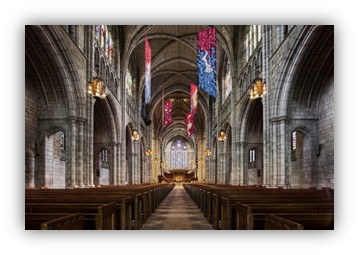

I have to concede too, that this might be one point where I think the puritans threw the baby out with the bathwater. They wanted to make the point that the Church was not a building but the people in the building, and that the true beauty of the Church was not the ornate architecture, stained glass, or costly adornments, but the spirit filled people in the church. To make this point, they made all their churches plain with very few decorations. The beauty of the church was seen when God’s people were gathered there.
I agree with the Puritans’ theology on that point. But I can’t get away from the fact that when God had the opportunity to tell Moses what He wanted in a house of worship, He wanted one that was full of color, images, and pictures that symbolized His relationship with them. He wanted it made with the most precious and costly of materials. He wanted it to look, feel, and even smell unique, like no other place.
It is not that God thought the real beauty of the tabernacle or the Temple was in the building and not in His presence among His people. But He knew that the beauty of the one could reinforce and remind the worshiper of the beauty of the other. It is not either or, but both and. You can’t walk into one of these cathedrals—places that are so different from every other place, places that were so costly to build, so huge, so beautiful, and not come to the conclusion that God’s beauty and worth is displayed in the grandeur of it.
What makes these massive windows and open arches possible are things called buttresses. You can see the buttresses running down the outside of the chapel. Can you see them?


Even more amazing to me, are flying buttresses that are seen on some gothic cathedrals. These buttresses are separate from the walls of the cathedral and have one or more arms that “fly out” and attach to the walls. Buttresses bear the weight of the roof so the walls don’t have to, and resist the force of the walls pushing out, making it possible for the walls to be lighter and safely have those huge arches and windows. Here is a picture of the Bourges Cathedral which has striking flying buttresses:

Buttresses serve as a great illustration of what Paul means when he says in Ephesians 4:2 that we are to bear with one another.
The Greek word literally means “to hold one’s self up against.” Some translations use the word forbearing. It means to put up with, to endure, to suffer. Much like a buttress bears the weight of the ceiling and keeps the walls they are attached to from falling, we are to bear with one another, living with and walking with one another in such a way as to support and uphold one another.
More tomorrow….

 Learning To Be Full Of Grace And Truth.
1 Comment