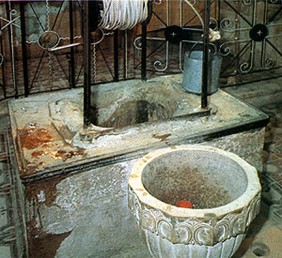
If you were to travel to the Middle East today, and head north from Jerusalem you would very soon come to the city of Askar. There you would find an old convent that has been built around a well. This well’s shaft goes down about 100 feet and there hits an underground spring that supplies it with very fresh and exceptional water. This well is agreed virtually unanimously by Jewish, Christian, and Muslim scholars alike to be a well Dug by the Patriarch Jacob whose story we have in Genesis.
We know from the account in Genesis that Jacob originally bought the land from the Ammorites for 100 pieces of silver. At some point, he dug a well there so he had a local source of water for his families and herds. It served him well during his life. He even at one point had to fight the Ammorites to keep it as they tried to take the land back by force.
In his will he left the land and the well to his son Joseph. When the Israelites left Egypt, they took the remains of Joseph with them as was his wish, and brought them back to the well of his father and buried him there. And there around that well, Joseph’s descendants lived.
As time went on, the Land of the Promise became the Land of Israel. The descendents of Joseph enjoyed the glory days of King David and Solomon. But Solomon’s son Rehoboam was a cruel and godless man. When he refused to admit that he was abusing his position as king, the descendants of Joseph and those of nine other tribes rebelled and set up their own kingdom: Samaria.
Hardly any time had passed before the sins of Rehoboam became the sins of the kings of Samaria as well. They began to worship other gods, they ignored the prophets God sent to them, and against God’s promise, gave up hope for the messiah to come through the Davidic line that they had come to hate.
God’s discipline against them went unheeded for so long that He allowed the Empire of Assyria to overtake them. Those who were not deported in the conquest ended up intermarrying with their conquerors who brought their pagan worship with them. This blatant disregard of God’s commands, gave rise to great contempt towards the Samaritans among the Jews.
Yet just after the time that God gave the Northern tribes that made up the nation of Samaria to the Assyrians, the prophet Isaiah, watching all this happen from Jerusalem in Judea, heard and recorded this word from God,
There will be a highway for the remnant of his people that is left from Assyria, as there was for Israel when they came up from Egypt.
In that day you will say: “I will praise you, O LORD. Although you were angry with me, your anger has turned away and you have comforted me.
Surely God is my salvation; I will trust and not be afraid. The LORD, the LORD, is my strength and my song; he has become my salvation.”
With joy you will draw water from the well of salvation.
Seven centuries pass. Hostility between the Jews and their half-brothers the Samaritans only grow worse and more bitter. So bitter in fact, that a Jew traveling from Jerusalem to Galilee would gladly add three days travel to their journey to take the scenic route by the sea rather than go through Samaria.
So we come to John’s account of Jesus meeting a Samaritan woman at this well in John 4:1-42. Jacob’s well, dug so many centuries before is still bringing water to his descendants. Here at this very significant place in Israel’s history, a place that Jews had long since written off, we see the fulfillment of Isaiah’s prophecy in the life of a Samaritan woman. Beside this well that had unfailingly supplied water to thirsty people for many centuries, is sitting the Source of Living Water, Jesus Christ.
This story is full of grace. What an amazing story of forgiveness! I want to help you see just how much is here.
- The boldness of Christ
asserts itself in verse 4, He had to go through Samaria. Jesus had to go. What grace is in that verse alone! This is no chance meeting. No unforeseen fortunate circumstance. Jesus took this road not merely to take the shorter route to Galilee, but to keep this divine appointment at Jacob’s well. - Coming here, and interacting with this woman teaches us that Jesus is willing to get his hands dirty. This woman was not someone any good bible believing Jew would give the time of day to, let alone ask for a drink. First because she was a Samaritan, second because of the lifestyle she was leading. Jesus says, My food, is to do the will of him who sent me and to finish his work. Jesus here is reaching into the muck and mire of racism, self-righteousness, personal sin, and ignorance to meet this woman. Searching for worshippers is a dirty business because we are dirty people in a dirty world.
- Jesus initiates the conversation. This woman was not coming to Jesus with a pricked conscience. She was not looking for forgiveness. She was not looking for grace. Jesus sought her out. He knows His sheep, and his sheep hear His voice. God does not wait for us to repent to seek us out. He does not wait for us to come out of hiding. He knows where we are. He seeks us out and comes to us.
- Jesus came to her with grace and truth. It is gracious for Jesus to speak to her and offer her salvation. But grace requires that certain truths be agreed upon. You cannot accept the mercy and grace of God’s forgiveness until you know that you need it.
- And lastly, it did not matter where she was, what race she was, what her business was, or what her sins were. God’s grace was bigger. Where sin abounds, grace abounds all the more. How wonderful that is!

 Learning To Be Full Of Grace And Truth.