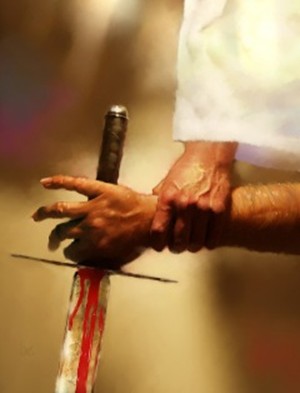
Jesus, knowing all that was going to happen to him, went out and asked them, “Who is it you want?”
“Jesus of Nazareth,” they replied.
“I am he,” Jesus said. (And Judas the traitor was standing there with them.)…
Then Simon Peter, who had a sword, drew it and struck the high priest’s servant, cutting off his right ear. (The servant’s name was Malchus.)
Jesus commanded Peter, “Put your sword away! Shall I not drink the cup the Father has given me?” (John 18:4-5, 10-11, NIV).
When Peter realized what was about to happen, he immediately tried to fight his way out of it. He was not going to let his Master be taken and killed. But Jesus stopped him and told him to let it happen. Put your sword away! Shall I not drink the cup the Father has given me? (18:11).
As I was thinking about this passage today two thoughts came to mind that I thought I would share with you.
-
While defending Jesus showed Peter’s devotion to Him, it was not necessary. I think even stronger words than that could be used: it was the wrong thing to do. That old saying “the road to hell is paved with good intentions” comes to mind. Peter loved Jesus so he wanted to protect Him and save Him from trouble. That was a good thing. He didn’t like the fact that Judas—his friend and fellow disciple—had sold out his Master to His enemies. Nothing wrong with that. He didn’t like seeing Jesus mistreated. Again, that was a good thing.
But Jesus didn’t need defending, and He rebuked Peter for doing so and for thinking He had to.
I think there is a lesson in that for the Church today. There are a lot of Christians who are, like Peter, upset and hurt and angry at how Jesus is treated by the world today. Like Peter, some feel led by their love and devotion to Jesus to defend Him. Peter took a sword to the ear of his opponent. We use a much more damaging weapon to the ear today—words. As well intentioned as we might be, when our defending is done at the expense of love, mercy, and humility, I hear Jesus saying the same thing: Put your sword away! Shall I not drink the cup the Father has given me? Jesus does not need defended. He is quite capable of taking care of Himself. If we want to show our love for Him, then we should show it in the way He commanded Peter to that night: If you keep my commands, you will remain in my love, just as I have kept my Father’s commands and remain in his love…This is my command: Love each other. John 15:10 and 17, NIV). We need to remember what Paul told us in Ephesians 6:12 (NIV), our struggle is not against flesh and blood, but against the rulers, against the authorities, against the powers of this dark world and against the spiritual forces of evil in the heavenly realms. You cannot simultaneously attack and love one another. Jesus will take care of Himself, let us be obedient and conduct ourselves in the truth and respond to others in grace.
-
Another lesson I take from Peter is that when we see something bad coming, or something bad happens, like Peter, we immediately look for a way out.
We don’t like to think that the dark valleys and bogs of suffering that beset us in life are places that God wants us to be in. It is not wrong to pray for God to spare us or save us from these times…even Jesus asked to be spared what was going to happen (Matthew 26:39).
This passage teaches us that sometimes we are supposed to go through the valley instead of avoiding it. Jesus had been telling His disciples that this would happen, and He spent the whole of that night telling them about it. This was not something that prayer was going to remove.
I am reminded of 43:1-2 (NIV),
Israel’s Only Savior
But now, this is what the LORD says—
he who created you, Jacob,
he who formed you, Israel:
“Do not fear, for I have redeemed you;
I have summoned you by name; you are mine.
When you pass through the waters,
I will be with you;
and when you pass through the rivers,
they will not sweep over you.
When you walk through the fire,
you will not be burned;
the flames will not set you ablaze.God does not promise that we will never suffer from floods, the pull of riptides, or be caught in the flames. He does promise that He will be with us in them, and will see us through them. That is never easy. It is hard to trust that God will provide and protect, and save in the midst of forces, circumstances, and even evil that we do not understand. Our need to survive often trumps our faith in these times, and we draw our swords and attempt to fight our way out. Jesus tells us to trust Him and His Father and commit ourselves to His love and care. If the Father could be trusted to lead Jesus to the cross and to the grave and still not lose Him, is there anything that we cannot trust God to bring us through? No, we may not have all the answers—indeed we may be baffled as to the purpose of things—but this passage lets us see why we can trust God to be our eyes when we cannot see, and why we can trust His love when we do not understand.

 Learning To Be Full Of Grace And Truth.
1 Comment