Tuesdays with Edwards!

One way you can tell the importance of a sermon to its author is in its re-preaching. This sermon Living Peaceably with One Another, which a young Edwards delivered at the congregational church in Bolton, CT in late 1723 (when he was only 20 years old) was later re-preached again at the same congregation and then again later when he was pastor at Northampton, MA (though the reproaching dates are not given).
Below is an image of page 4 of the original manuscript curtesy of the Beinecke Rare Book & Manuscript Library at Yale. The beginning of this week’s selection begins about halfway down the page.
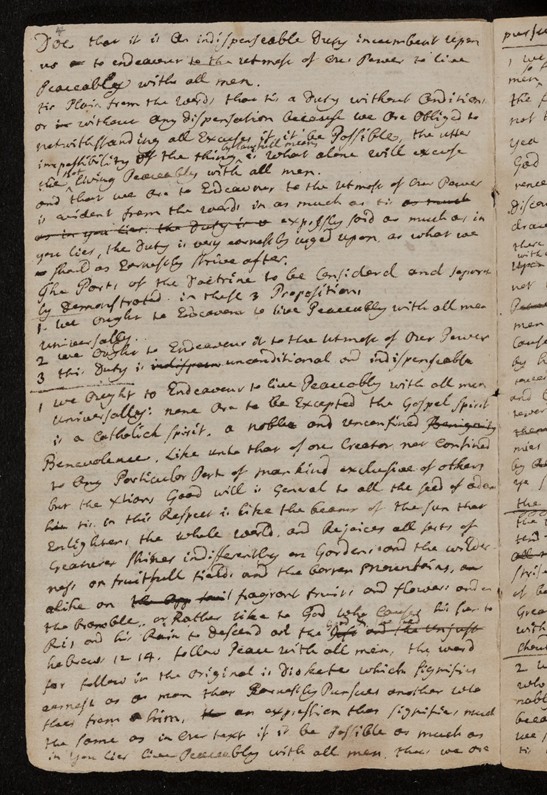
You can read the sermon in its entirety at www.edwards.yale.edu. This selection can be found in Sermons and Discourses, 1723-1729, ed. Kenneth P. Minkema, The Works of Jonathan Edwards, vol. 14 (New Haven: Yale University Press, 1997) Pages 121-124.
***
We ought to endeavor to live peaceably with all men universally. None are to be excepted. The gospel spirit is a catholic spirit, a noble and unconfined benevolence, like unto that of our Creator, not confined to any particular part of mankind exclusive of others; but the Christian’s good will is general to all the seed of Adam. ‘Tis in this respect like the beams of the sun that enlightens the whole world and rejoices all sorts of creatures, shines indifferently on gardens and the wilderness, on fruitful fields and the barren mountains alike, on fragrant fruits and flowers and on the bramble; or rather like to God, who causes his sun to rise and his rain to descend on the good and the bad. Hebrews 12:14, “Follow peace with all men.” The word for “follow” in the original is diokete, which signifies “earnest,” as a man that earnestly pursues another who flees from him, an expression that signifies much the same as in our text: “If it be possible, as much as in you lies, live peaceably with all men.” Thus we are pursue after peace with all men universally.
First. We ought to follow peace with unjust and sinful men as well as with those who are to appearances true Christians and the fearers of God. This we are to do by all lawful means. Not that we are to countenance them in any wickedness; yea, we ought to manifest zeal for the glory of God and interest of religion, and the utmost abhorrence of wickedness in whomsoever it is found, and to discountenance such persons as are notorious sinners, to withdraw from them and not to company with them. But yet there is no need of our causing contention and strife upon their account, if it be possible to avoid it. We need not be at peace with their practices, but we may be at peace with their persons. To make the wickedness of men the cause of contention and strife in us, is to make one sin the cause of another. We cannot please the devil better than by hating men’s persons under pretense of duty. Our carriage towards sinful men’s persons ought to be manifestation of pity and compassion and grief for their sin, and every action of ours towards them ought to be from love towards and peace with them, and from a hatred to their worst enemies, that is, their sins. We cannot show friendship more than by hating their worst enemies. Luke 6:35, “And ye shall be the children of the Highest: for he is kind unto the unthankful and to the evil.” Alas, if we should take the liberty upon every occasion to fight and quarrel and contend with men from this excuse, that they are wicked men, the world would be full of nothing but fighting and strife and the most woeful confusion; and Christianity, instead of being the gospel of peace, would be the greatest incendiary of strife: for if we are to fight with all but godly men, how few are there but that we should contend with them.
Second. We ought to endeavor to live in peace with those who are of different opinions from us. ‘Tis a most unreasonable thing to take the liberty of contending with men because they cannot see with our eyes. If this were granted, we should be at war with the greatest part of the world. ‘Tis as unreasonable to strive with others because they can’t be in everything of our minds, as to quarrel with another because he differs in the color of his hair or the features of his face. No, we have not thus learned Christ Jesus, we don’t learn to do thus out of the gospel of God. Christianity teaches us other things. We have not so learned Christ. We ought to receive those who differ from [us] only in circumstantial matters in religion into our charity, and look on them as Christians, and live with them as such. Romans 14:1–5, “Him that is weak in the faith receive you, but not to doubtful disputations. For one believeth that he may eat all things: another, who is weak, eateth herbs. Let not him that eateth despise him that eateth not; and let not him which eateth not judge him that eateth: for God hath received him. Who art thou that judgest another man’s servant? to his own master he standeth or falleth. Yea, he shall be holden up: for God is able to make him stand. One man esteemeth one day above another: another esteemeth every day alike. Let every man be fully persuaded in his own mind.”
Yea, if another man differs from us in the substantials and fundamentals of religion, however erroneous he is and however pernicious his tenets, yet we ought, as much as in us lies, [to] endeavor to live peaceably with him. Our text seems to be put in such universal terms, with an eye to the heathen amongst whom the Christians in those times lived: they are required, if it be possible, to live peaceably with them.
And certainly, if differences in opinion with respect to religion ought not to be the cause of our not living peaceably with men, much less ought differences of opinion in other matters, however positive and assured we may be in any matter, and others will not think as we do and are as positive in the contrary opinion. How foolish and childish is it to break peace upon this account. Because others are tenacious of their opinions against what we think to be reason plain and evident, shall we afflict and bite each other upon this account? How unreasonable is this. If this were allowed, there would not be two persons in the world that would be at peace one with another. If any will make contention upon this account, they act very contrary to the gospel of peace. The Corinthians fell out in matters of opinion the Apostle writes to them upon. 1 Corinthians 11:16, “But if any man seem to be contentious, we have no such custom, neither the churches of God.”
Third. We ought to our utmost to endeavor to live in peace, be at peace with those who have injured, wronged and abused us. We must not only live at peace with those that are friendly to us. It will not suffice that we don’t quarrel and fall out with our good neighbors or near relations, that we let them alone that let us alone, and to be at peace with men while they do not abuse us, and those that are kind to us. But we are commanded to love those [that] hate us; we must do all the good we can to them that do what evil they can to us; to be peaceable and quiet and well-wishers to them who are full of hatred and strife towards us. Matthew 5:43–44, “Ye have heard that it hath been said, Thou shalt love thy neighbor, and hate thine enemy. But I say unto you, Love your enemies, bless them that curse you, do good to them that hate you, and pray for them which despitefully use you, and persecute you”; and [Matthew 5:46, “For if ye love them that love you, what reward have ye? do not even the publicans the same?”
Some say they do love them that do them wrong and wish them no hurt, but wish them well, that are mistaken: they have no sincere and hearty love to them, but would feel really the better for their misfortunes, would smile to hear that they met with as bad injuries as they did to them; not only because they hoped it would enlighten their eyes to see their souls for their own good, but would really be secretly glad because evil is befallen them. They know not their own hearts. We ought to have a love that is true, inward and sincere to our injurers, whether they injure us in our estates, or names, or bodies; whether they injure us by one vice or another, whether by covetousness and a craving after much of the world, or by their malice or backbiting. 1 Thessalonians 5:14–15, “Be patient toward all men. See that none render evil for evil unto any; but ever follow that which is good, both among yourselves, and to all men.” It would be endless to reckon up all the places of Scripture for the proof of this so certain a duty.

 Learning To Be Full Of Grace And Truth.