If you read my blog even half regularly, you will soon find that I am a big fan of Jonathan Edwards.
Who is that you ask?
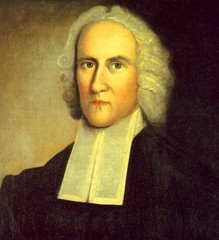 If you were to ask a historian who was the most influential religious figure in American history, chances are the top answer would be Jonathan Edwards (1703-1758). Edwards was the pastor in Northampton, MA from 1727-1750, a missionary to the Mohawk and Mohican Indians in Stockbridge, MA from 1750-1757, and was elected as the third president of Princeton University. Edwards involvement in and support of the Connecticut River Revival in 1734 and Great Awakening in 1740-42 garnered him an international reputation. He is a major figure in Christian history.
A sermon of his that I like to re-read around Easter is The Agony of Christ. Not often in print I have taken the liberty of editing the official transcription of the original sermon for you. While what follows has in no way been given the stamp of approval by the guys at the Jonathan Edwards Center at Yale, it is I think a fair job. Edwards can be difficult to read, but if you take your time, you will get a lot out of this. It is a fantastic sermon. Since it is also quite long, I will post it in chunks.
Ready?
Here we go!!!
The Agony of Christ
And being in an agony he prayed more earnestly and his sweat was as it were great drops of blood falling down to the Ground. Luke 22. 44.
Our Lord Jesus Christ in his original nature was one that was infinitely above all suffering for he was God over all blessed forevermore; but by when he became man he did not only he was not only capable of suffering but had that nature that is weak, remarkably feeble, and exposed to suffering. The Human Nature on Account of its weakness is in Scripture often compared to the Grass of the field which easily withers and decays; so it is compared to a Leaf and the dry stubble and a blast of wind, a shadow and the nature of a feeble worm. Man is said to be but dust and ashes to have his foundation in the dust and to be crushed before the moth.
It was this nature with all its weakness and exposedness to suffering, that Christ who is the Lord God omnipotent, took upon him He did not take the human nature on him in in its first most perfect and vigorous state, but in that Poor broken feeble broken state it is in since the fall and therefore Christ is called a tender plant and a root out of a dry Ground. Isai. 53:2 “For he shall grow up before him as a tender plant, and as a root out of a dry ground. Thus, as Christ’s principal Errand into the world was suffering, so he came into the world fit, so Agreeable to this Errand on which he came, he came most able with such a nature and in such circumstances as most made way for his suffering.
And so his whole life was filled up with suffering. He began to suffer in his Infancy but his suffering increased the more he Drew to the close of his Life. His suffering after his public ministry was begun was probably much Greater than before, and the latter part of the time of his public ministry seems to be distinguished by suffering. The Longer Christ lived in the world, the more men [saw] and heard of him, the more they hated him. Enemies were more and more Engaged by the Continuance of the opposition that he made to their Lusts, and the Devil having been often baffled by him grew more and more Enraged and strengthened the more and more against him, so that the Cloud over Christ’s head Grew Darker and Darker as Long as he lived in the world till it was in its Greatest blackness when he hung upon the Cross and Christ cried out, “My God, my God, why hast thou forsaken me?” [Matthew 27:46].
Before this it was Exceeding dark in the time of his Agony in the Garden which was before this we have an account [of] in the text words now Read.
In discoursing from this Text I shall not, as usual, found my discourse on doctrine or particular Propositions as Doctrine raised from the words. But that which I shall make the subject of my Present discourse is the same, Christ’s agony, the same that is the subject of the words of the Text. And in discoursing of Christ on this subject, I would proceed in the following method:
The word Agony properly signifies an Earnest strife [—] and such as is in wrestling running or fighting, and therefore in that 13th [chapter] of Luke at the 24th v. “strive to Enter in at the strait Gate.” In the Original that is translated strive is Agonizesthe, Agonize; “Agonize to Enter in at the strait gate.” The word is especially used for that sort of strife that the in those days used to be in the Olympic Games in Greece which were Games that were Instituted by public Authority in which men strove for the mastery in running, wrestling, and other such Kinds of Exercises; and a prize was set up that was bestowed on the Conqueror. Those that strove for the mastery in these Games were in the Language that was used then said to Agonize. Thus, the apostle writing to the Corinthians that were a people that lived in Greece where the public Games were, in 1 Cor. 9:25, speaking of these Olympic Games their striving for the mastery in these Games, says and every man that striveth for the mastery is temperate in all things. Now in the original, it is every one that Agonizes is temperate in all things. And the place that was where these Games were was Called Agon, or the Place of Agony. And the word is particularly used in the Scriptures for that sort of striving that that is in Earnest Prayer wherein Good Persons do as it were wrestle with God. They are said in Scripture to Agonize or be in an Agony in prayer. So the word is used Rom 15:30, “Now I beseech you, brethren, for the Lord Jesus Christ’s sake, and for the love of the Spirit, that ye strive together with me in your prayers to God for me.” The word which in the original is that you agonize together with me. So Colossians 4:12, “always laboring fervently for you in prayers;” in the original it is agonizing for you.
So that when it is said in the Text that Christ was in an Agony, the meaning is that his soul was in a Great and Earnest strife and Conflict. It was so in two Respects viz. 1). as his soul was in a Great and sore Conflict with those terrible and amazing views and apprehensions that he then had, and 2). also as he was at the same time in a great Labor and Earnest strive with God in Prayer; so that his agony Consists in these two parts. And therefore I would discourse on this subject of the Agony of Christ by distinctly considering these two parts of it both which are spoken of in the Text under these two suppositions:
That the soul of Christ in his agony in the garden had
- That part which consisted in that sore Conflict that his soul then had with those terrible views that he then had.
- The Great and Earnest strive the Labor and strife that his soul was then in with God in prayer.

 Learning To Be Full Of Grace And Truth.